

Mineral Gallery
Meteorites, giant quartz and four billion years of Earth in monumental 18th-century cases.
18th c. collections
The deep archive
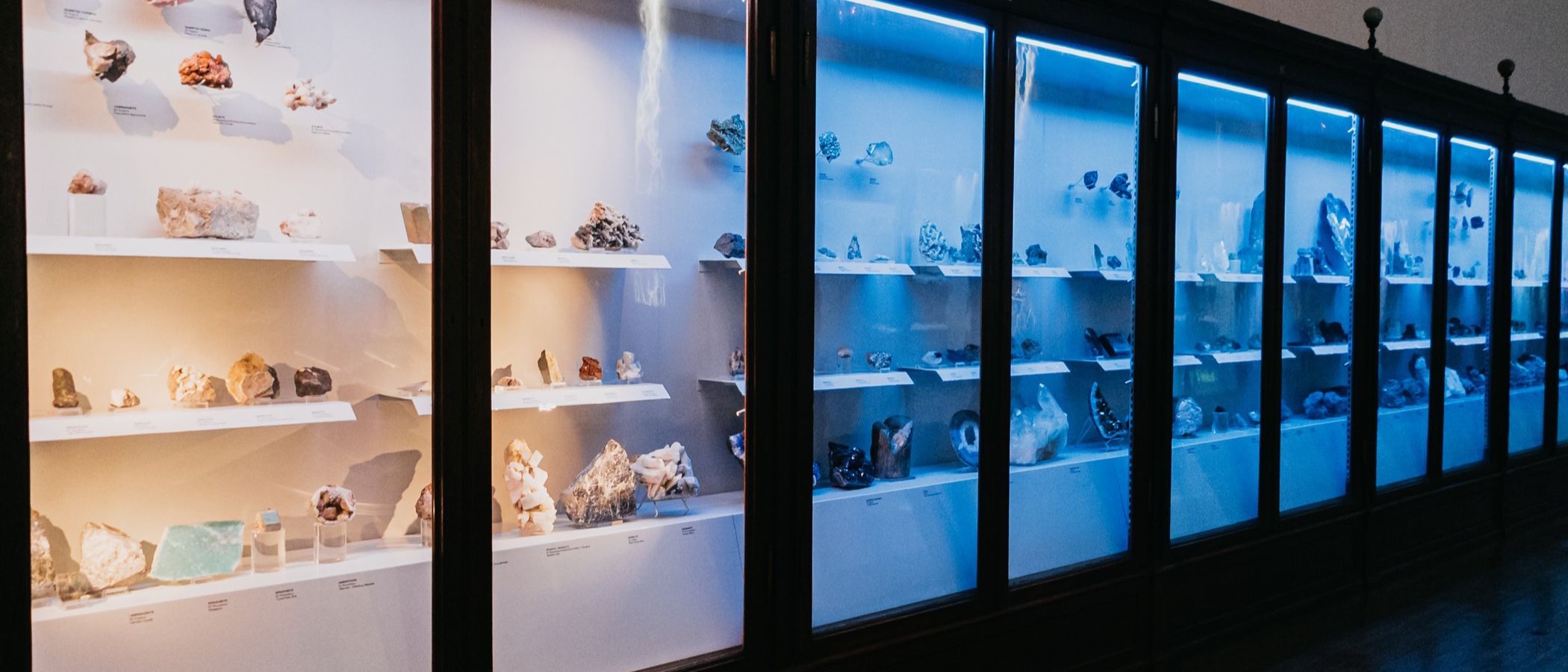
The university's library keeps seven centuries of writing; this room keeps four billion years of Earth. The historic mineralogy collection, begun with the eighteenth-century push to teach natural history from real specimens, fills monumental display cases from that same era — towering woodwork built to hold the planet's greatest hits. On the Science Museum circuit at the Colégio de Jesus, it is the shortest visit on the hill with the longest timespan.
Greatest hits of a planet
The headliners announce themselves. Meteorites — actual visitors from space, older than anything formed on Earth. Quartz crystals grown to improbable size, glassy and cold. And running through the cases, the story of Portuguese mining: the ores of tin, copper and wolfram that were pulled from the country's hills and mattered enough to shape its economy. Every specimen was collected to teach — this was never treasure for treasure's sake, but a syllabus written in stone.
Your twenty minutes
Twenty minutes covers the gallery, and it works beautifully as a palate-cleanser between the busier stops of the circuit. Read the room in two registers at once: the specimens, ancient beyond imagining, and the cases, which are themselves museum pieces of Enlightenment carpentry. When you're there, find the biggest quartz and get close. The surface is fogged like breath on a window, the facets throw slow, pale gleams as you move, and the room is so quiet you can hear your own footsteps — the newest thing, by far, in four billion years.
Gallery
© Universidade de Coimbra / Felippe Vaz © Universidade de Coimbra / Felippe Vaz © Universidade de Coimbra / Felippe Vaz
Know before you go
Accessibility
Partially accessibleLocated in the historic Colégio de Jesus; access involves steps.
Tickets that include this space
- Self-guided3h
Joanina Library + University + Science Museum
The full story in one ticket: the gilded Joanina at your timed slot, the Royal Palace and Chapel, and the Science Museum circuit across the hill.
Price on requestper person
- Self-guided2h30
University + Science Museum
The Royal Palace, St Michael's Chapel and the full Science Museum circuit — seven centuries of teaching, minus the queue for the library.
Price on requestper person